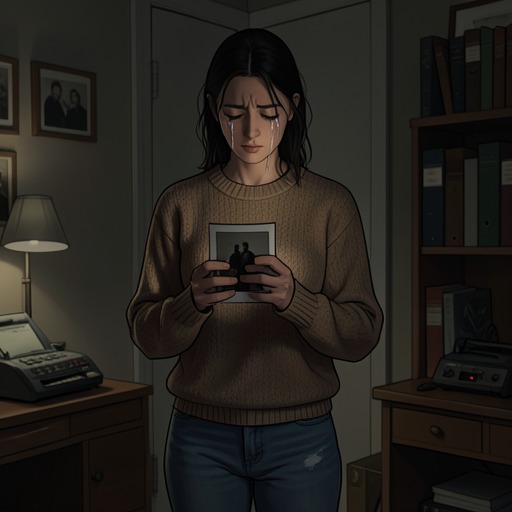
Violet's grief and survivor guilt
All the Bright PlacesViolet Markey’s grief and survivor guilt take shape around two deaths she cannot undo: her sister Eleanor Markey’s, and Theodore Finch’s. In the aftermath, she repeatedly turns loss into a question about her own responsibility—whether she said or did enough, and whether she could have changed what happened. Her movement toward living with grief begins when she speaks openly to her parents, insisting that remembering the dead is not the same as pretending that the living are fine.
The first loss and the silence that follows
Before Eleanor’s death, Violet and Eleanor had created EleanorandViolet.com, an online magazine that brought together their different perspectives on fashion, beauty, boys, books, and life. A mention in an interview by Eleanor’s friend Gemma Sterling, a star of the Web series Rant, had tripled the site’s following. After the sisters’ car went through the guardrail, however, Violet stopped working on it. The project had depended on their shared voices; without Eleanor, Violet could not see its purpose. She experiences the crash not only as the loss of her sister but as the sudden loss of her own words.
The site’s silence is one expression of a larger retreat. Violet had already tried to make herself quiet and unobtrusive after her parents’ family life changed, hoping not to add to their burdens. That earlier habit of shrinking away is distinct from her grief, but it gives her silence a history: after Eleanor dies, withdrawal becomes bound to the sense that speech and creation belonged to the sisters together. The unfinished site remains a concrete reminder of a relationship that cannot resume in its old form.
Places where loss becomes real
The A Street Bridge gives grief a physical location. Theodore Finch runs past the damaged stone guardrail and sees the gap left in the wall, a cross lying beside it, and scattered remnants of the car below in the dried riverbed. He does not know who placed the cross. The question remains open, but the objects make the crash tangible beyond the private memories of those who survived it. The bridge’s damage connects Violet’s continuing grief for Eleanor to a place another person can encounter and recognize.
After Theodore’s disappearance, Violet searches his room and closet for something that might explain where he has gone. She takes one of his black shirts and examines the space he left behind, including the night sky on the ceiling and the Post-it notes on the wall. The closet’s familiar intimacy becomes inseparable from his absence: the objects remain, but they cannot tell her what happened. Her search shows grief at work as both attachment and an attempt to make absence legible, even when the available traces offer no complete answer.
Calendar, memory, and self-blame
At a family dinner, Violet anticipates that her parents may condemn Theodore’s suicide, contrasting his death with Eleanor’s death in the crash. Rather than stay for that conversation, she asks to be excused and goes upstairs. In her closet, she unfolds a calendar and looks at the many blank days she did not mark because they were days she spent with Theodore. The empty spaces turn shared time into something she can count, while also making its ending newly visible.
Her thoughts move from anger at Theodore to wishes that she had known, been enough, or done something. She wonders whether his death was her fault and asks herself why she was not enough. These thoughts register survivor guilt, not evidence that she caused his death. Their force comes from the difference between what she can know and what she longs to change: she can revisit her choices, but cannot go back and secure a different outcome.
The narrative also gives the reader access to Theodore’s private crisis, including his self-condemnation and his fear that Violet would discover what he believed was wrong with him. After taking sleeping pills, he changes course, leaves home, and seeks emergency medical help. This context does not resolve Violet’s later questions or establish what she knew at the time. Instead, the contrast makes clear that the story’s account of his inward struggle and her bereavement are not identical: his hidden thoughts cannot be converted into a simple explanation that would make her responsible for his death.
Speaking to her parents
Violet eventually asks her parents to talk about Eleanor and not to let her disappear from family conversation. She says she cannot accept an appearance of normality when she misses her sister. She also admits that she suggested Eleanor take the bridge home on the night of the crash, and apologizes for that suggestion. The admission reveals a specific source of her guilt: a remembered decision that she can replay, although she cannot know that a different suggestion would have prevented the crash.
As she continues, Violet acknowledges another concealed part of her life. She had secretly continued seeing Theodore after telling her parents that the relationship was over. She does not present this secrecy as the cause of his death; rather, she wants to stop tiptoeing around Eleanor, Theodore, and her parents because silence is making it harder to remember the people she loves. She recalls the distinctive ways Eleanor said her name, preserving the sound of her sister’s voice through particular memories rather than through an idealized account of the past.
Violet tells her parents that she loved Theodore and that he had been good for her, even though they disapproved of him and she wishes he had not died. She allows love, hurt, and anger to coexist. Her mother answers directly that what happened is not Violet’s fault. The family then cries together and comforts one another. That reassurance does not erase either death or instantly end Violet’s guilt; it gives her a relationship in which the guilt can be spoken and challenged rather than borne alone.
Continuing connection and an unfinished future
Violet’s movement beyond grief is not framed as forgetting Theodore. At the Blue Hole, she remembers him beneath the open sky and thinks about the places she still has to wander. She imagines her own epitaph as unwritten and feels new capacities beginning to open. The moment does not cancel her pain; it places remembrance beside a future that remains hers to live.
The pattern is different from her earlier response to EleanorandViolet.com. At first, Violet cannot imagine continuing a project created by two sisters after one of them is gone. Later, she argues that the dead need not be completely absent if the living preserve their memories. Her grief remains attached to concrete traces—the abandoned website, the damaged bridge, the calendar, Eleanor’s remembered voice, and Theodore’s room—but those traces no longer point only toward what cannot be recovered. By speaking with her parents and imagining future wanderings, Violet begins to carry love for both Eleanor and Theodore without treating survival as proof of failure or responsibility.